Відповіді
Відповіді: Стр.174
Готова відповідь до завдання Стр.174 з ГДЗ Англійська мова 8 клас Несвіт 2016.
Англійська мова (English), 8 клас · Відповіді
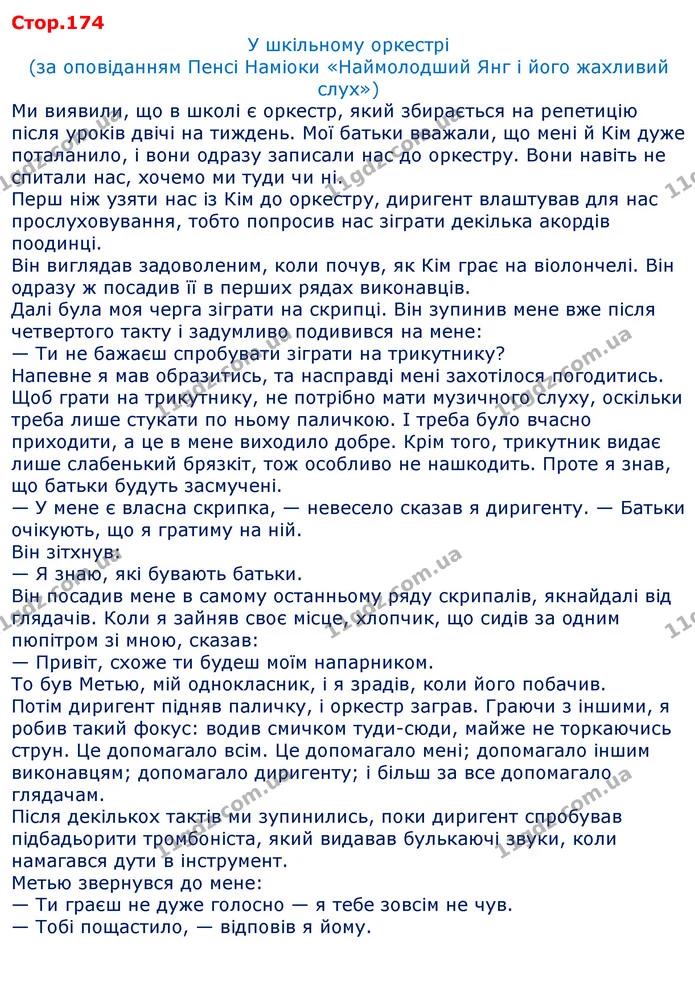
Текстова відповідь
Міс Хані (Роальд Дал)
Матильда трохи спізнилася зі школою. Більшість дітей починає ходити до початкової школи в п’ять років, а то й раніше, а батьки Матильди не дуже переймалися освітою доньки. От вони й забули про те, щоб завчасно її влаштувати, їй було п’ять із половиною років, коли вона вперше зайшла до школи.
Сільська школа для молодших учнів була цегляною спорудою і звалася «Початкова школа Кранчем Холл». У ній вчилося близько 250 дітей від п’яти до майже дванадцяти років...
Матильду, звичайно, зарахували до наймолодшого класу, де вчилося 18 хлопчиків та дівчаток її віку. їхню вчительку звали міс Хані, і їй було років 23-24. У неї було миле овальне личко, блакитні очі, а її волосся було світло-каштановим. Вона була струнка і тендітна.
Міс Дженіфер Хані була людиною м’якою і тихою і ніколи не підвищувала голос. Вона рідко посміхалася, проте кожен учень у класі обожнював її. Здавалося, що вона розуміє всі страхи маленьких дітей, які прийшли до класу, де мають слухатися і робити, що скажуть... Після звичного зачитування прізвищ дітей міс Хані видала кожному учневі по новенькому зошиту.
— Сподіваюся, ви всі взяли з собою олівці, — сказала вона.
— Так, міс Хані, — відповіли вони.
— Добре. Так от, сьогодні для кожного з вас — найперший день у школі. Це початок щонайменше 11 років навчання, яке всі ви пройдете. І шість із них ви проведете тут, у Кранчем Холл. Вашу директорку звуть міс Транчбулл. Я вам дещо про неї розповім задля вашого ж добра.
Вона наполягає на суворій дисципліні в школі, і якщо ви дослухаєтесь до моєї поради, то докладатимете всіх зусиль, щоб добре поводитися в її присутності. Ніколи не сперечайтеся з нею. Ніколи не суперечте їй. Завжди робіть те, що вона каже. Якщо ви потрапите їй під гарячу руку, вона вас знищить, як морквину в овочерізці. Всі ви вчините мудро, якщо запам’ятаєте, що місс Транчбулл діє дуже суворо стосовно порушників шкільної дисципліни. Я, — продовжувала міс Хані, — хочу допомогти вам дізнатися якнайбільше, доки ви в школі, бо я знаю, що це в подальшому полегшить вам життя. Так от, до кінця цього тижня я очікую, що кожен із вас знатиме напам’ять таблицю множення на два.
А через рік, я сподіваюсь, ви знатимете всі таблиці множення до дванадцяти. Якщо знатимете, це вам страшенно допоможе.
Стор.172 Впр.2
Find the words and phrases in the story that have the meanings given below.
1. A process of learning and getting knowledge at school, college, university — education. 2. Long before the time something is expected, or happens — in advance. 3. To speak louder when you are angry — to raise voice. 4. A plan or preparation you make for some event — arrangement. 5. Very seldom — rarely. 6. To feel that something is important and worth worrying about — to care about. 7. To begin studying at school — to start school. 8. To like somebody or something very much — to adore. 9. A feeling when you are afraid of something or somebody — fear.
Стор.172 Впр.3
Explain the meaning of the words and phrases.
Дивиться визначення цих слів і речень у попередній вправі.
to start school — to go to school for the first time; to care much — to worry about something or somebody very much; education — a process of getting knowledge at school; arrangement — previous agreement to do something; in advance — do earlier or beforehand; to raise voice — to say something loudly; rarely — not often; fear — to scare something; to adore — to love something or somebody very much.
Стор.172 Впр.4
Choose the correct phrase(s) from the text to complete the sentences.
1. Matilda was a little late in starting school. 2. Matilda’s parents didn’t care much about their daughter’s education. 3. So they’had forgotten to make the proper arrangements in advance. 4. Miss Jennifer Honey was a mild and quiet person who never raised her voice. 5. She rarely smiled but every child in the class adored her. 6. Miss Honey seemed to understand all the fears of small children. 7. All of children will be wise to remember that they must do their best to behave in the headmistress’ presence.
Стор.173 Впр.5
Find the sentences in the story to talk about:
a) Matilda’s parents didn’t care much about their daughter’s education so they had forgotten to make the proper arrangements in advance.
b) The village school for younger children was a brick building called Crunchem Hall Primary School. There were about two hundred and fifty pupils aged from five to just under twelve years old.
c) Miss Honey was twenty-three or twenty-four. She had a lovely pale oval face with blue eyes and her hair was light-brown. Her body was slim and fragile. Miss Jennifer Honey was a mild and quiet person who never raised her voice. She rarely smiled but every child in the class adored her. She seemed to understand all the fears of small children who for the first time in their lives had to come into the classroom and to obey orders.
Стор.173 Впр.6
Answer the questions.
1. When do most children begin studying at Primary School?
Most children begin studying at Primary School at five or even just before.
2. Did Matilda’s parents care much about their daughter’s education?
No, Matilda’s parents did not care much about their daughter’s education.
3. How many children were there in Matilda’s class?
There were eighteen other children in Matilda’s class.
4. What kind of a person was Miss Honey?
Miss Honey was a mild and quiet person.
Стор.173 Впр.7
Choose the correct item to complete the sentences.
1. Most children begin Primary School (a) at five or even just before. 2. Matilda’s parents (b) had forgotten to make the proper-arrangements. 3. The village school for younger children was (c) a brick building. 4. Miss Honey had (b) a lovely pale oval face with blue eyes. 5. She seemed to understand (c) all the fears of small children who for the first time in their lives had to come into the classroom. 6. Miss Honey said: (a) «It is the beginning of at least eleven long years of schooling that all of you are going to go through».
Стор.174 Впр.8
Number the events in order they happen in the story.
1. D. Matilda’s parents had forgotten to make the proper arrangements for school in advance. 2. B. Matilda has come to the bottom class of Crunchem Hall Primary School. 3. C. The author describes Miss Honey’s appearance. 4. A. Miss Honey is telling pupils about their studying at school.
Стор.174 Впр.9
Complete the statement.
The text is about (c) Matilda’s first day at Crunchem Hall Primary School.
Стор.174 Впр.10
Say and tick the statements T (True) or F (False).
True. 1. Matilda’s parents didn’t care much about their daughter’s education.
False. 2. There were about two hundred pupils aged from five to just under twelve years old at Crunchem Hall Primary School.
There were about two hundred and fifty pupils aged from five to just under twelve years old at Crunchem Hall Primary
School.
True. 3. Naturally Matilda was put in the bottom class, where there were eighteen other small boys and girls about the same age as her.
False. 4. Their teacher was called Miss Honey, and she was thirty-three or thirty-four.
Their teacher was called Miss Honey, and she was twenty-three or twenty-four.
False. 5. She often smiled and every child in the class adored her.
She rarely smiled and every child in the class adored her.
True. 6. She seemed to understand all the fears of small children who for the first time in their lives had to come into the classroom.
Стор.174 Впр.11
Complete the sentences given below.
1. Most children begin Primary School at five or even just before. 2 The village school for younger children was a brick building called Crunchem Hall Primary School. 3. Miss Jennifer Honey was twenty-three or twenty-four.
Стор.178 Впр.1
Answer the questions.
1. Do you like to read books?
Yes, I like to read books.
2. Do you prefer reading books to watching TV?
No, I prefer watching TV to reading books.
3. How often do you go to the library?
I do not go to the library very often.
Читачка (Роальд Дал)
Брат Матильди Майкл був нормальним хлопчиком, а от його сестра всіх здивувала. У півтора року її мова була ідеальною, і вона знала стільки слів, скільки й більшість дорослих. Батьки прозвали її галасливим базікалом. Вони їй казали, іцо маленькі дівчатка мають бути на виду, проте їх не має бути чутно. У трирічному віці Матильда навчилась читати, вивчаючи газети й журнали, що валялися в будинку. У віці чотирьох років вона вже вміла швидко і добре читати і, звичайно, почала шукати інші книжки. Єдиною книжкою вдома була «Швидка кулінарія», що належала мамі. Вона прочитала її від обкладинки до обкладинки і вивчила напам’ять всі рецепти. Тоді вона вирішила, що їй потрібно щось цікавіше.
— Тату, —сказала вона, — чи не міг би ти купити мені книжку?
— Книжку? — запитав він. — Навіщо тобі та книжка?
— Читати, тату.
— Чим тобі не подобається телевізор, люба? У нас чудовий телевізор, а ти просиш книжку. Ти стала балуваною, дитино!
Майже щодня по обіді Матильда залишалася вдома сама. Її брат (на п’ять років старший за неї) ходив до школи, батько ходив на роботу, а мати їздила грати в лото до міста за вісім миль.
Коли батько відмовився купити їй книжку, Матильда вирішила піти до громадської бібліотеки в селі. Прийшовши, вона відрекомендувалася бібліотекарці, місіс Фелпс. Дівчинка запитала, чи можна трохи посидіти й почитати книжку. Місіс Фелпс здивувалася, що така маленька дівчинка прийшла сама, без батьків. Але вона люб’язно сказала дівчинці, що, звичайно, можна і вона їй рада.
— Скажіть, будь ласка, де дитячі книжки? — запитала вона.
— Вони он там, на нижніх полицях, — відповіла їй місіс Фелпс. — Хочеш я знайду тобі книжку з багатьма малюнками?
— Ні, дякую, — сказала Матильда, — я впевнена, що впораюсь.Із того часу щодня по обіді, щойно мати їхала грати в лото, Матильда йшла до бібліотеки. Дорога забирала лише 10 хвилин, і це дозволяло їй тихенько посидіти в затишному куточку дві години й читати одну книжку за одною. Коли вона прочитала всі дитячі книжки в бібліотеці, то почала шукати щось інше. Місіс Фелпс весь час із великою цікавістю спостерігала за нею. Тож вона підійшла до дівчинки й запитала:
— Тобі допомогти, Матильдо?
— Я думаю, що ще мені почитати, — відповіла Матилвда. — Я закінчила всі дитячі книжки.
— Ти хочеш сказати, що переглянула всі малюнки?
— Так, але крім цього я також прочитала книжки.
***
За тиждень Матильда закінчила «Великі сподівання» на 411 сторінок.
— Вона мені дуже сподобалась, — сказала вона місіс Фелпс. — А містер Діккенс ще що-небудь написав?
— Дуже багато чого, — сказала місіс Фелпс. — Вибрати тобі ще одну?
Протягом наступних шести місяців Матильда під пильним оком місіс Фелпс прочитала книги Чарлза Діккенса, Шарлотти Бронте, Джейн Остін, Томаса Гарді, Мері Вебб, Редьярда Кіплінга та інших...
Одного разу місіс Фелпс сказала:
— Чи ти знаєш, що в громадських бібліотеках, як наша, можна брати книжки додому?
— Я про це не знала, місіс Фелпс, — відповіла Матильда. — Можна й мені їх брати?
— Звичайно, — сказала місіс Фелпс. — Коли вибереш книжку, яку хочеш прочитати, неси їі до мене, щоб я могла зробити відмітку, і вона твоя на два тижні. Можеш взяти не одну, якщо хочеш.
Стор.178 Впр.2
Explain the meaning of the words and phrases.
A chatterbox — a person, who talks all the time; a library — a place, where you can take books to read at home; a librarian — a person, who works in the library and gives you books; to introduce — to say, what is your name; to borrow — to take something for some time and then give it back; to read from cover to cover — to read the whole book from beginning to end; to learn by heart — to remember every word and be able to retell it.
Стор.178 Впр.3
Find the words in the story that have the meanings given below.
1. To tell somebody your name and give some general information about you — to introduce. 2. To learn something (a poem, a story) so that you can remember it very well — to learn by heart. 3. To take something for a short time and then to give it back — to borrow. 4. A person who talks all the time — a chatterbox. 5. A place where there are a lot of books and you can borrow them without paying money — a library. 6. A person who works in the library and helps you to choose books — a librarian.
Стор.178 Впр.4
Choose the correct word to complete the sentences.
1. The parents called her a noisy chatterbox. 2. By the time she was three, Matilda had taught herself to read by studying newspapers and magazines. 3. Matilda went to the public library in the village. 4. She had read this book from cover to cover. 5. Matilda introduced herself to the librarian. 6. Public libraries allow you to borrow books.
Стор.178 Впр.6
Answer the questions.
1. What kind of a child was Matilda?
Matilda was a child to surprise everyone.
2. At what age could she read?
She could read at the age of three.
3. Why did she ask her father to buy a book?
She asked her father to buy her a book because there was only one book at home and she had already read it.
4. Where did she go to read books?
She went to the library to read books.
Стор.179 Впр.7
Choose the correct item to complete the sentences.
1. Matilda was a child to surprise everyone because (a) she could talk very well. 2. Matilda asked her father to buy her (c) a book. 3. One day Matilda decided (b) to go to the public library. 4. When she went to the library, she (a) read all the children’s books. 5. Matilda was happy to know that (b) she could take the books home.
Стор.179 Впр.8
Number the events in order they happen in the story.
1. C. By the age of one and a half her speech was perfect and she knew as many words as most grown-ups.
2. D. The walk took only ten minutes and this allowed her two hours to sit quietly in a cosy corner and read one book after another.
3. B. Within a week, Matilda had finished Great Expectations which contained four hundred and eleven pages.
4. A. «When you have chosen the book you want, bring it to me so I can make a note of it and it’s yours for two weeks. You can take more than one if you wish».
Стор.179 Впр.9
Complete the statement.
The text is about (b) a clever girl who wanted to read books.
Стор.180 Впр.10
True. 1. By the age of one and a half her speech was perfect and she knew as many words as most grown-ups.
False. 2. By the time she was three, Matilda had taught herself to read by studying books that lay around the house.
By the time she was three, Matilda had taught herself to read by studying newspapers and magazines that lay around the house.
True. 3. At the age of four, she could read fast and well and she naturally began looking for other books.
False. 4. Her father allowed her to buy a book.
Her father did not allow her to buy a book.
True. 5. From then on, every afternoon, as soon as her mother had left for bingo, Matilda went to the library.
False. 6. Over the next six months Matilda read the books by Charles Dickens and Charlotte Bronte.
Over the next six months Matilda read the books by Charles Dickens, Charlotte Bronte, Jane Austin, Thomas Hardy, Mary Webb, Rudyard Kipling and others.
Стор.180 Впр.12
Complete the sentences given below.
1. Matilda was a child to surprise everyone because by the age of one and a half her speech was perfect and she knew as many words as most grown-ups and by the time she was three, Matilda had taught herself to read by studying newspapers and magazines that lay around the house. 2. She liked going to the library because there was a cosy corner there where she could read books.
Стор.181 Впр.1
Answer the questions.
1. What does music mean for you?
Music means a lot for me because I listen to music every day.
2. What is the orchestra?
Orchestra is a group of musicians playing different instruments.
3. Can anybody play in the orchestra?
No, not anybody can play in the orchestra, only particular musicians.
4. In which way does the conductor lead the orchestra?
The conductor usually shows everybody in the orchestra what to do and when to start.